
Lead-acid, gel or lithium: how to choose your forklift battery
The battery is the most expensive component you will replace over the life of an electric forklift. It can account for around 30% of the value of a new machine, and equipment that works for ten years will normally need more than one replacement.
Even so, it is the purchase most often made blind: people order a battery identical to the one they had, without checking whether that one was the right fit. And today there are three technologies on the market, not two. This guide from ULMA Multibrand Spare Parts, part of ULMA Lifting Solutions, explains how to identify the battery your equipment uses, how lead-acid, gel and lithium differ, which is the most cost-effective for your use, and what to check before switching from one to another.
How to identify the battery your forklift uses
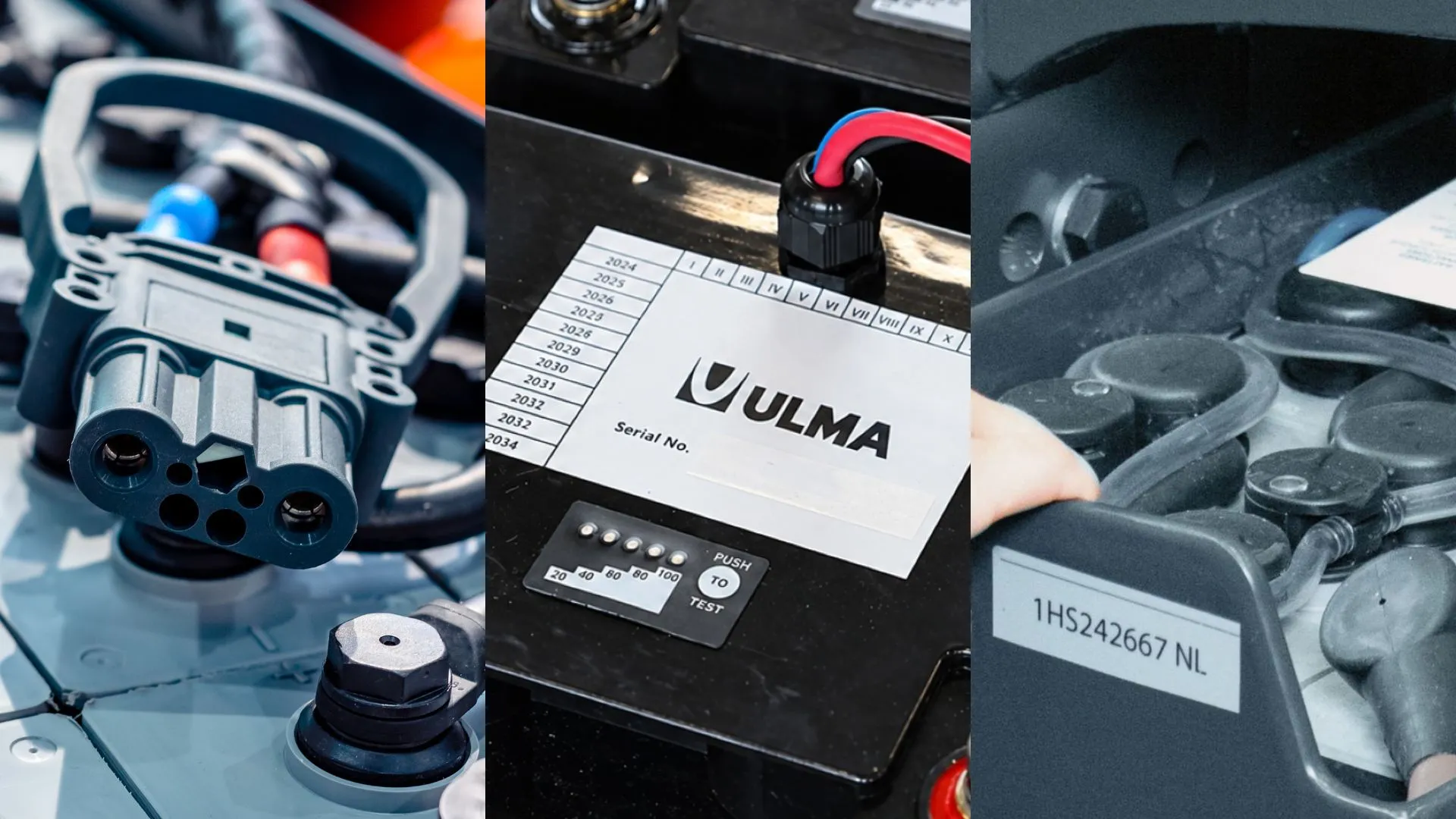
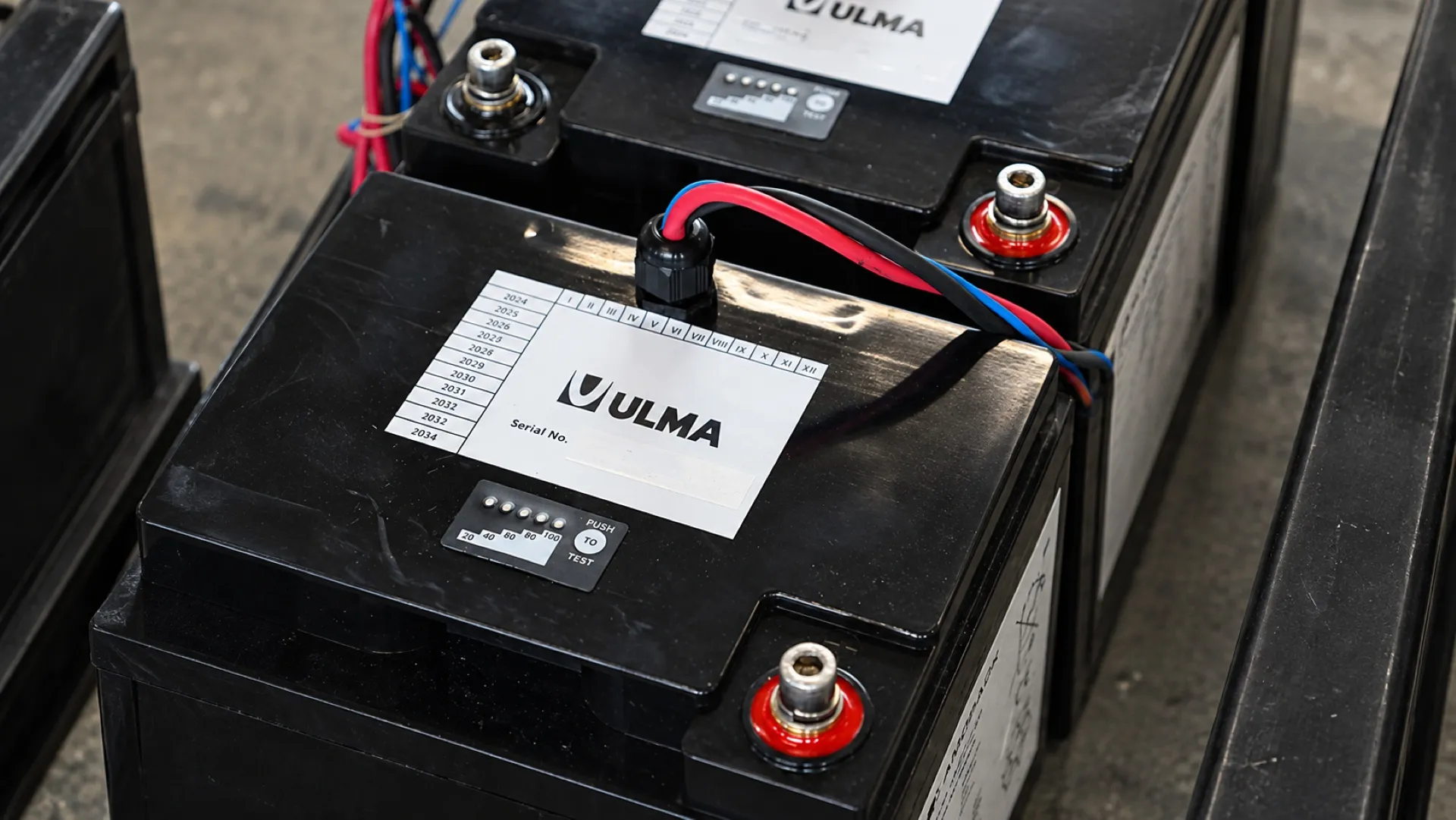
Before asking for a price you need four pieces of information, and the first three are on the battery itself, on the nameplate:
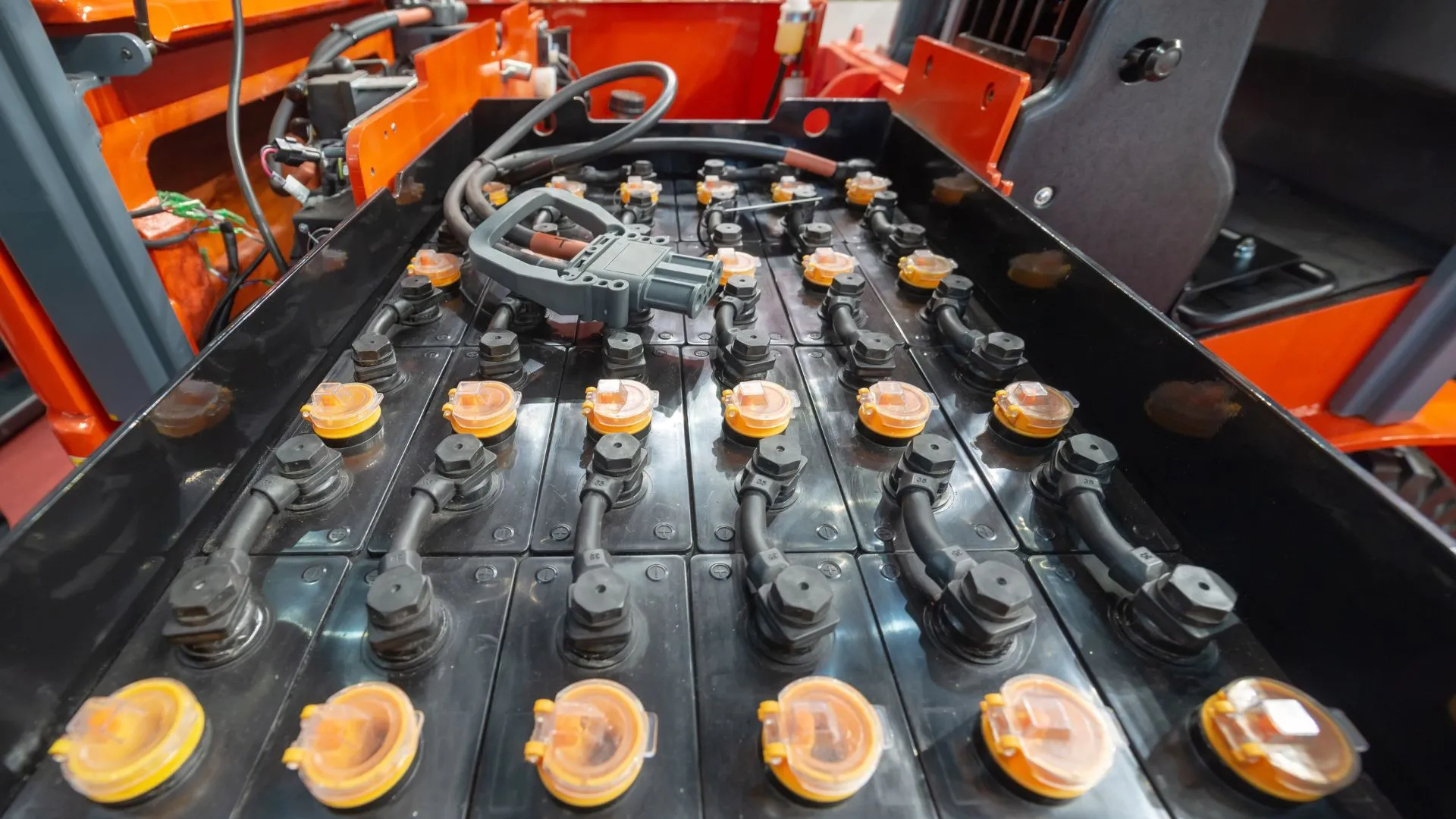
- Voltage, in volts. The usual values on forklifts are 24 V, 48 V or 80 V. A 48 V battery is made up of 24 cells of 2 V.
- Capacity, in ampere-hours (Ah). This is the energy it stores. 750 Ah is a common value on electric counterbalance trucks.
- Number of plates per cell, shown as 2PzS, 4PzS, 5PzS or 6PzS. The PzS designation identifies the tubular plate type used in traction batteries, and the number indicates how many each cell carries: more plates mean more capacity and more weight.
- Tray dimensions and terminal position. The battery has to fit the exact compartment of your machine, so you have to measure length, width and height and check which side the connector exits.
With these four details, a battery is described without ambiguity. For example: 48 V, 6PzS, 750 Ah, DIN tray, cable exit on the right.
Not sure about your forklift's nameplate?
Access the ULMA multibrand spare-parts catalogue and search by brand (Linde, Toyota, Nissan, Mitsubishi, Jungheinrich, Still, Caterpillar, Hyster, Yale, Clark...), or send us a photo of the nameplate and our technical team will confirm the exact part without you having to register. We hold immediate stock with fast delivery throughout Spain.
The three technologies compared
In forklifts and industrial equipment, three technologies coexist today. The usual comparison pits lead-acid against lithium and forgets about gel, which nonetheless solves one specific problem very well: sites where you cannot ventilate as flooded lead-acid demands.
| Feature | Flooded lead-acid | Gel | Lithium-ion |
|---|---|---|---|
| Maintenance | Periodic water top-ups and cleaning | No electrolyte-level maintenance | No maintenance |
| Ventilation | Requires a ventilated charging room | Very low gas emissions | No ventilated room required |
| Cycle life | Around 1,500 at 80% discharge | Fewer cycles than flooded lead-acid | 3,000 to more than 3,500 |
| Opportunity charging | Penalises service life | Not really recommended | Accepted without penalty |
| Charging time | 8 to 12 hours plus cooling | Similar to flooded lead-acid | 1 to 3 hours |
| Cold-weather behaviour | Loses capacity markedly | Similar to lead-acid | Better, with suitable electronics |
| Entry cost | The lowest | Intermediate | Two to three times lead-acid |
| Where it fits best | One or two shifts with scheduled overnight charging | Premises without adequate ventilation, cleaning equipment, platforms | Two or three shifts, usable breaks, little space for a charging room |
A point about gel worth being clear on: it is also a lead battery, but with the electrolyte immobilised. That removes water top-ups and reduces gas emissions, which makes it suitable for premises without a proper charging room. In return it tolerates fast charging less well and delivers fewer cycles than a well-maintained flooded tubular battery. It is not an improved version of lead-acid: it is a solution to an installation problem.
Every industrial traction battery we sell at ULMA Multibrand Spare Parts is tested and certified. We hold immediate stock of the main types: lead-acid (with different plate configurations), gel and lithium-ion, as well as smart single-phase and three-phase chargers.
What determines the price of a battery
The price of a traction battery depends on four things, and it is worth knowing them before comparing quotes:
- Voltage and capacity, which define the real size of the battery. This is the factor that weighs most.
- The technology. At equal voltage and capacity, lithium starts from two to three times above lead-acid.
- The charger. It is not interchangeable between technologies, so if you switch from lead to lithium you have to add it. In lead-acid, a high-frequency charger costs more than a conventional one but extends battery life.
- The accessories that are not always included: an automatic water-filling system for flooded batteries, tray, connector or compensating ballast.
That is why two quotes with the same final price may not be comparable. Always ask for the breakdown.
At ULMA Spare Parts we provide detailed quotes with a breakdown of components and chargers. If you need to replace several units, we can offer a free battery-audit service to optimise your investment.
The two factors that shorten a battery's life the most
Temperature
This is the most underestimated factor. The life of a lead battery is reduced by roughly half for every 10 degrees above the 25-degree reference. In manufacturer figures, a traction battery that delivers more than 1,800 cycles at 25 degrees drops to around 1,300 at 35 degrees. A hot aisle in August does not tire the battery: it takes almost a third off its life, and that shows up on no indicator.
In cold conditions the opposite happens, and it is just as surprising: you don't use more battery, you simply have less. At 0 degrees you have around 75% of the capacity available, and at 18 below zero around 40%. That is why a cold-store forklift starts each shift with considerably less energy than the label claims.
Charging habits
The correct charging window for lead-acid is narrower than it seems. You should not discharge below 20% of remaining capacity, because the sulphate crystallises irreversibly and no charger reverses that. But nor should you charge when the battery has barely been used, because every plug-in counts as a cycle.
And there is a part of the protocol almost no one respects: cooling. The usual rule is eight hours of use, eight of charging and eight of cooling. When opportunity charging is used on a lead battery, the manufacturer usually also requires a weekly equalisation charge and a long cooling period. In other words, opportunity charging on lead does not come free: it carries a calendar toll that is rarely planned for.
This is where lithium has the advantage: it accepts partial and opportunity charging without penalty. If your operation has usable breaks (rest periods, shift changes, meal breaks), lithium recovers the investment quickly.
Switching from lead to lithium: what to check first
Changing the battery chemistry is not just swapping a part, because the battery does two jobs at once. As well as supplying energy, in an electric forklift it acts as a counterweight. That is why the machine's nameplate shows a minimum battery weight alongside the load capacity.
A lithium pack weighs considerably less than an equivalent lead pack, and that lightness is one of its advantages. But if it goes into the compartment without compensating for the difference, the centre of gravity shifts and the machine's stability margin is no longer the one it was tested to. That is why a conversion of this kind has to be validated by the equipment manufacturer, not just the battery supplier.
Before deciding, it is worth checking five things:
- The minimum battery weight indicated on your machine's nameplate, and whether the lithium assembly meets it, with ballast if necessary.
- The forklift manufacturer's validation for that specific conversion.
- The charger, which is not the same and is not interchangeable.
- The building's electrical installation and the power available at the charging points, especially if you are going to charge several machines at once.
- The real shifts and breaks: without usable breaks, opportunity charging — lithium's main advantage — goes unused.
⚡ Do you need to validate a lead-to-lithium battery migration?
Our technical team at ULMA Multibrand Spare Parts reviews those five points free of charge and confirms whether the conversion is viable for your machine. Contact us with your equipment details (make, model, nameplate) and we will arrange a consultation.
When lithium isn't worth it
It is worth saying, even though we sell both technologies. Lithium does not always pay off.
On a single shift with low utilisation, in seasonal use of three or four months a year, or in fleets of one or two machines working four hours a day, the return on investment stretches beyond five years. In those cases, a well-sized and well-charged lead battery is still the right decision.
Lithium shines where there is intensity: two or three shifts, usable breaks for charging, little space for a charging room, or environments where changing the battery is an awkward operation. If your operation is not in that group, the extra cost takes time to pay back.
Regulations applicable in Spain
For the storage and use of lithium batteries, the most specific Spanish reference is the guide published by BEQUINOR in July 2024, the first to bring the matter down to industrial installations. Alongside it apply the Regulation on Fire Safety in Industrial Establishments (Royal Decree 2267/2004), Regulation (EU) 2023/1542 concerning batteries and waste batteries, and the ADR for transport.
From the European battery regulation, one date is worth remembering: from 18 February 2027, industrial batteries above 2 kWh must carry a digital passport, with information on composition, state of health and traceability.
At ULMA Multibrand Spare Parts we are permanently up to date on Spanish and European regulations for industrial batteries. If you need advice on regulatory compliance at your installation, our technical team is available.
Frequently asked questions
How long does a forklift battery last?
A lead-acid traction battery delivers on the order of 1,500 cycles, which is about five years charging it once a day. A lithium one ranges between 3,000 and more than 3,500 cycles. The real figure depends above all on working temperature, charging habits and maintenance.
Can you fit a lithium battery in an old forklift?
In many cases yes, but it is not a straight swap. You have to check that the minimum battery weight indicated on the machine's nameplate is met, add ballast if necessary, change the charger and obtain the equipment manufacturer's validation, because the conversion affects stability. We coordinate that validation.
Does charging the battery during breaks damage it?
In lead-acid, yes in the long run. Every time it is plugged in a full cycle is consumed, even if it is only charged a little. Charging twice a day halves the years of service. In lithium this does not happen: it accepts partial charging without penalty, which is one of its great advantages in operations with breaks.
What does 6PzS mean on a battery?
It indicates the number of tubular plates each cell of the battery carries. More plates mean more capacity and more weight. It is one of the details needed to order the correct replacement, along with the voltage, the capacity in ampere-hours and the tray dimensions.
What is the difference between a gel battery and a lead-acid battery?
Gel is also a lead battery, but with the electrolyte in gel form rather than liquid. It needs no water top-ups and emits barely any gas, so it can work in premises without a ventilated charging room. In return it handles fast charging less well and offers fewer cycles than a well-maintained flooded tubular battery. It is a solution to installation problems, not an improved version.
Does the same charger work for any battery?
No. Each technology needs its own charging curve, and using a charger that does not match shortens battery life or damages it outright. When switching from lead-acid to lithium you also have to change the charger. We have smart single-phase and three-phase chargers suited to each type.
How do I know if my battery is compatible with my forklift?
Your battery's nameplate must match the machine's nameplate in voltage (V), capacity (Ah) and number of plates (PzS), as well as the tray dimensions. If in doubt, send us your machine's nameplates (a photo will do) and our team will confirm compatibility. No surprises: at ULMA Multibrand Spare Parts we verify every part before confirming the price.
Which forklift brands do your replacement batteries cover?
We specialise in multibrand traction batteries. We cover all the main ones: Linde, Toyota, Nissan, Mitsubishi, Jungheinrich, Still, BT-Toyota, Caterpillar, Hyster, Yale, Clark, Manitou, Doosan, Atlet, Fiat, Heli, Hangcha, Baoli, Tailift and many more. If your forklift is another brand, write to us and we will source the compatible battery.
Do you offer battery installation or replacement service?
Yes. As well as selling spare parts, we coordinate certified technical services throughout Spain. Contact our team with your location and machine type, and we will arrange the installation. We offer online or on-site service depending on your location.
What happens to the old battery?
Our technicians are responsible for delivering the old battery to authorized waste management facilities for processing and recycling.
Battery and spare-parts catalogue for forklifts
In the ULMA Spare Parts shop you will find an extensive catalogue of replacement parts for forklifts of every brand: lead-acid batteries (different configurations 2PzS, 4PzS, 5PzS, 6PzS), gel batteries and lithium-ion batteries, as well as smart single-phase and three-phase chargers. We also stock hydraulic attachments, drive wheels, tyres, safety components and other specific spare parts for forklifts, aerial work platforms, industrial cleaning equipment and agricultural machinery.
Access to the catalogue with exact part numbers, real-time availability and prices requires registration, which is free and designed for businesses. Once registered, you will have access to:
- Immediate stock of multibrand spare parts
- A complete technical data sheet for each product
- Compatibility verified by machine brand
- Fast delivery throughout Spain
- Free technical advice
If you are not sure which battery or spare part your equipment needs, you can write to us with the nameplate details and our technical team will confirm the exact part number, availability and price before you buy anything. In addition, if you need to replace several units or migrate to lithium, we coordinate a free technical audit.
If you are not sure which battery or spare part your equipment needs, you can write to us with the nameplate details and our technical team will confirm the exact part number, availability and price before you buy anything. In addition, if you need to replace several units or migrate to lithium, we coordinate a free technical audit.